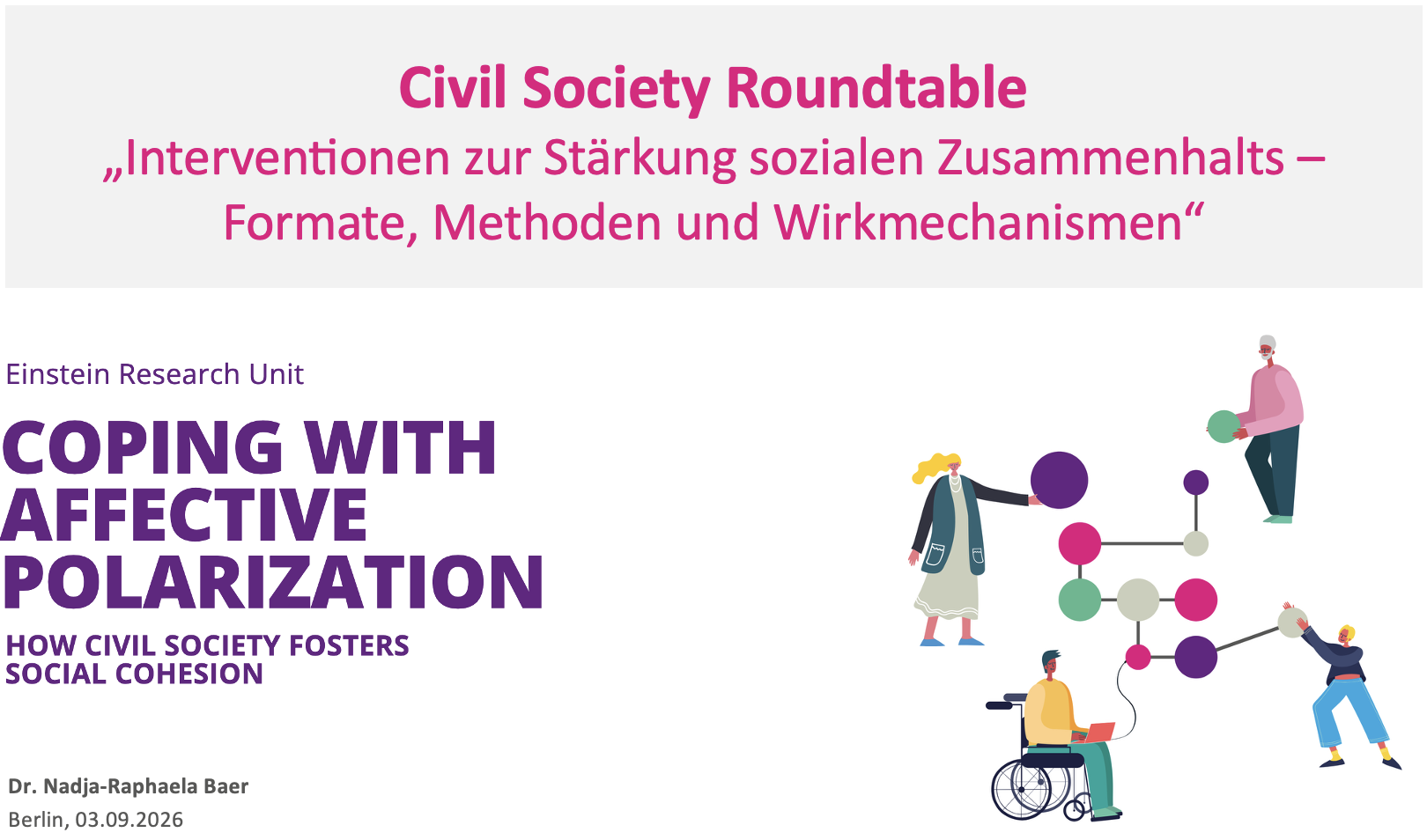
Civil Society Roundtable: “Interventions to Strengthen Social Cohesion – Formats, Methods, and Mechanisms of Action”
Insights from research
The day opened with a session on current intervention approaches from within our Einstein Research Unit:
Larissa Knöchelmann and Lucas Köhler (Humboldt-Universität zu Berlin) presented how trainings in empathy and intellectual humility – the willingness to recognize that one’s own views might be wrong or incomplete – can be a promising way to strengthen skills such as perspective taking. These skills help people see the world through the eyes of those who think differently and engage with them more openly.
Stefanie Hechler, Diego Dametto and Mikkel Rasmussen (Freie Universität Berlin) introduced an online self-tracking intervention in which participants record how often they talk about politics in their everyday lives – with family, friends or colleagues. The idea: simply becoming aware of one’s own conversation habits can encourage people to engage more often and more deliberately in political exchange, including with those who see things differently.
In the third presentation, Nadine Knab and Viviane Bagińska (Charité Universitätsmedizin Berlin) shared an experimental approach to moving beyond black-and-white thinking. Instead of sorting political views into two opposing camps, the aim is to foster a more nuanced understanding: recognizing that people’s attitudes are often more complex and less extreme than they appear – which can make the other side seem less threatening and open up space for dialogue.
Together, the three inputs showed different ways in which research can help counter the harmful effects of affective polarization – such as hostility, distrust and seeing political opponents as enemies rather than fellow citizens.
Insights from practice
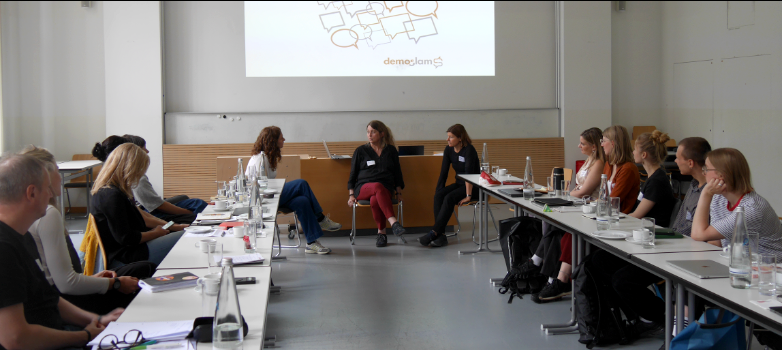
In the interactive practice segment, Leonie Pessara (MAGNET – Werkstatt für Verständigung) introduced participants to Demoslam, a dialogue format that brings people with differing perspectives together for constructive exchange on controversial social topics. Through hands-on exercises in perspective-taking and active listening, participants experienced firsthand how the format creates a protected space for different experiences and viewpoints to be voiced.
The afternoon turned to practice-based insights from civil society:
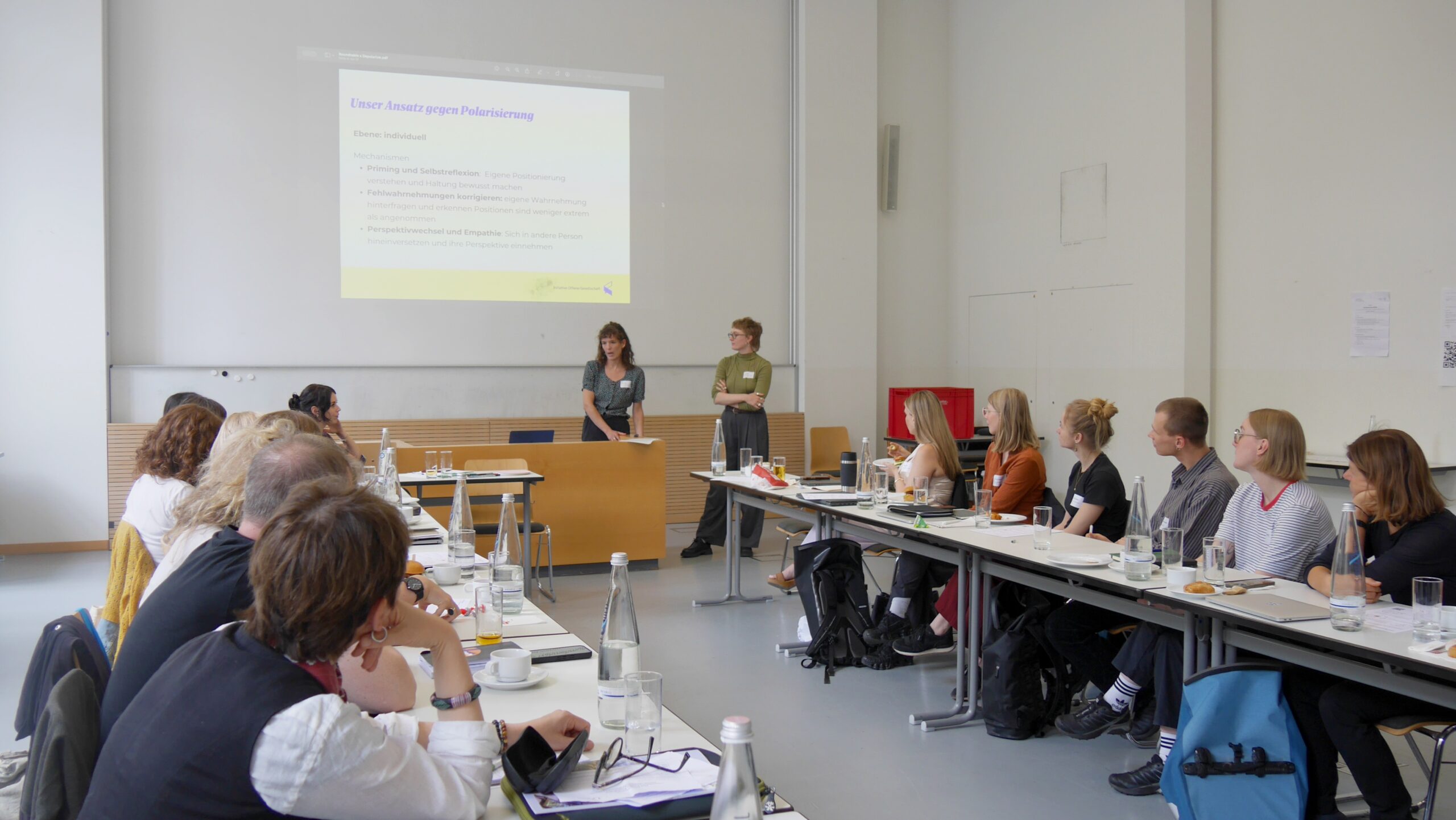
Lea Pehnt and Lotte Kirch (Initiative für offene Gesellschaft e.V.) presented the DEPOLARIZE toolkit, which translates research findings into interactive methods tested in schools and other public settings. Nicolas Stampe (ZADA e.V.) introduced “Challenge Your Perception,” an immersive 600-square-meter walk-through parcours that uses audiovisual installations to help young audiences engage with antisemitism and the influence of populism and disinformation through experiential, socio-psychological learning.
These projects showed how research-based ideas can be turned into different formats that reach people beyond academia – in classrooms, public spaces and exhibitions.
Closing discussion
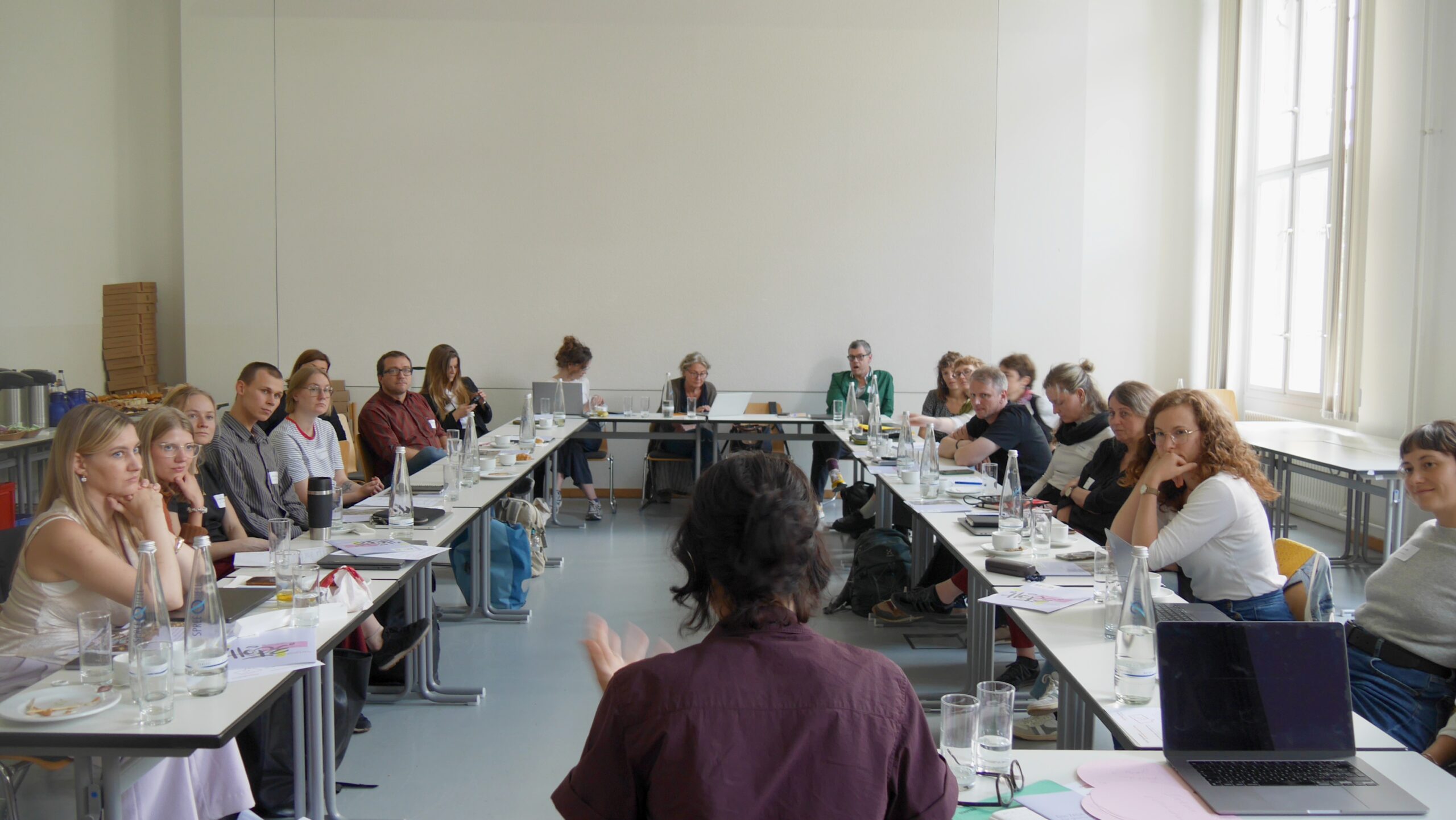
In the closing discussion, participants reflected together on what characterizes successful intervention approaches, the conditions under which they work, and what impulses could inform the further development of effective practice. The exchange showed that research and practice already work hand in hand in many ways – and how much both gain from developing interventions together.
We thank all participants for sharing their projects, questions, and ideas, and look forward to continuing this exchange!