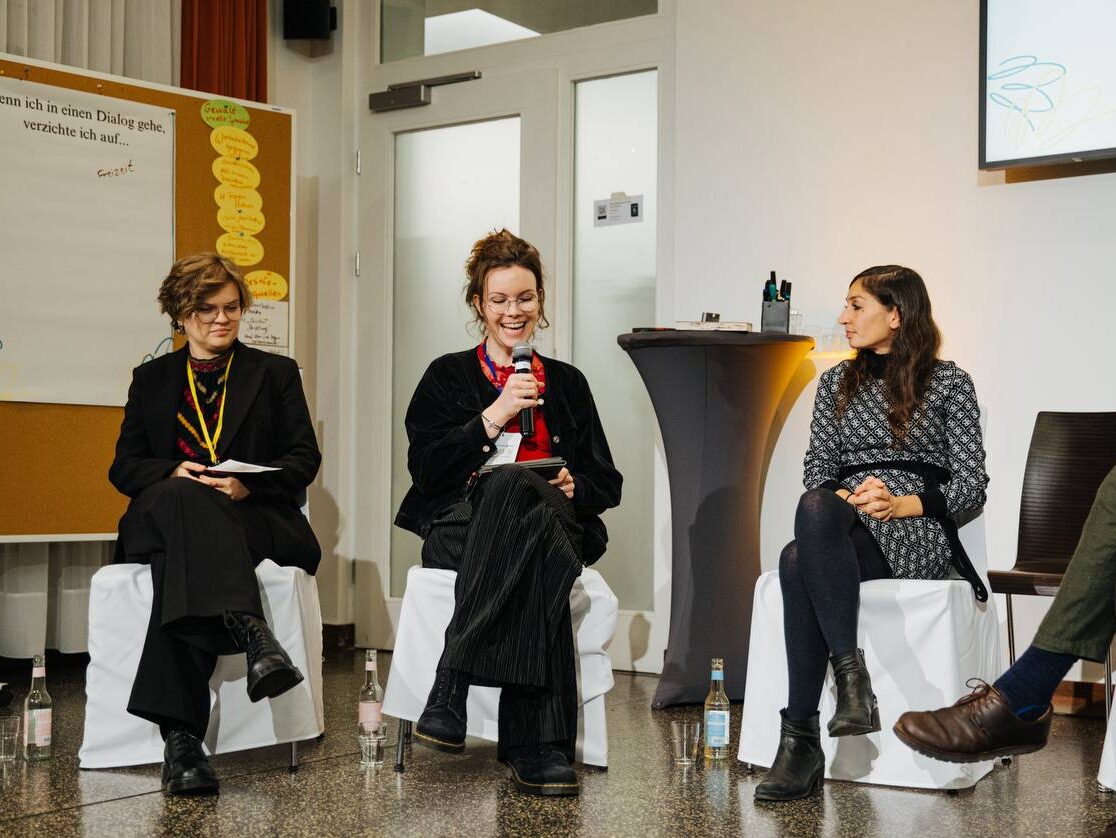
How can dialogue succeed in times of social media, disinformation, and heated political debates? More than 70 participants addressed this question at the symposium “Talking to each other! But how?”, which took place as part of the German-Ukrainian Dialogue project.
The event offered a variety of perspectives on the topic: in addition to conversations with Dr. Eugen Pissarskoi and Gilda Sahebi, participants were able to learn about practical approaches to dialogue work in interactive workshops.
The event concluded with a panel discussion featuring Dr. Larissa Knöchelmann, Dr. Eugen Pissarskoi, Gilda Sahebi, and Kateryna Pavlova. Together, they discussed questions such as: Who benefits from polarization? Who do I direct my anger at? And who am I actually talking to?
This brought together different perspectives on the possibilities and limitations of dialogue.
A key finding of the symposium was the realization that people are less polarized on many issues than is often assumed. At the same time, there are clear differences in how we deal with conflictual issues.
The discussions also made it clear that dialogue always requires clear boundaries that must be continuously renegotiated—a skill that must be practiced. An important starting point for this is self-reflection: Where are my trigger points, and how can I remain capable of acting despite my emotions?
Dialogue thus remains possible, but it is a conscious decision to engage in a conversation that can also be exhausting. However, dialogue is becoming all the more important, especially against the backdrop of polarization and divisive narratives that often benefit authoritarian forces.
Further information on the symposium can be found here.